When a Bigger Venture Fund Becomes a Different Investment

I recently spoke with the GP of an established Silicon Valley venture firm, now on its fourth fund. He told me that its first fund had already returned 1.5 times investors’ capital and still held a stake in a unicorn. LPs were willing to commit more. The firm nevertheless continued raising funds of $50 million.
Her explanation was straightforward: that size was the sweet spot for deploying capital efficiently and repeating an investment strategy that was already working. Raising more would have required changing the model.
That conversation captures what matters about venture capital fund size. A manager’s ability to raise more money can grow faster than its ability to invest that money on equally attractive terms.
For an LP, the next, larger fund may be a different investment, even when the team and stated strategy remain the same. A larger fee base can improve the management company’s economics. The LP’s return depends on whether the additional capital can be invested well.
A strategy proven at €30 million needs new evidence at €100 million
Consider a manager moving from a €30 million fund to a €100 million fund. Keeping the same number of companies and the same proportion of commitments allocated to initial investments would require initial tickets to grow by roughly 3.3 times. A €500,000 check becomes approximately €1.7 million.
The spreadsheet can make that change instantly. The market has to accept it.
A founder may welcome a €500,000 specialist alongside a lead investor. That allocation might reflect the fund’s technical expertise, speed, relationships or usefulness to the company. Asking for €1.7 million changes the conversation. There may be no room left in the round. The lead may want that ownership. The founder may prefer to spread the remaining allocation among several investors.
The first question is whether the manager can actually obtain larger allocations in the companies it wants to back.
Taking more ownership may also require becoming the lead. That means persuading founders to choose the firm to set terms, coordinate the financing and potentially take a board seat. A strong record as a follower does not establish that founders will entrust the manager with that role.
The second question is whether founders will choose the manager to lead.
A manager that earned access by being fast, collaborative and easy to accommodate alongside established leads must demonstrate that its advantage survives this change. Hiring more analysts can increase screening capacity. It cannot by itself create founder trust or a history of leading competitive rounds.
There are other ways to deploy the larger fund. The manager can back more companies, allocate more to follow-ons, invest at later stages or extend the investment period. Each changes something material: selectivity, partner workload, entry prices, reserve decisions or the timing of deployment.
Growth can work. But the evidence from the €30 million strategy must be connected to the choices required at €100 million. A successful first fund alone cannot make that connection.
Smaller funds can make more exit outcomes matter
A smaller fund has a straightforward economic advantage: a successful investment needs to generate fewer absolute euros to have a meaningful effect on the whole fund. That gives a disciplined early-stage strategy more ways to produce a significant contribution from an exit.
Assume a fund owns 3% of a company at exit, after dilution. A sale producing €500 million of equity proceeds for shareholders generates €15 million for that fund, assuming pro-rata distributions.
Fund commitments | Proceeds from the investment | Share of fund commitments |
|---|---|---|
€30 million | €15 million | 50% |
€100 million | €15 million | 15% |
€300 million | €15 million | 5% |
Illustrative gross proceeds before carry and fund-level deductions, assuming no preference distortions. These percentages are contributions relative to commitments, not investment profits or net LP returns.
The company and its exit are identical in all three cases. Their importance to the fund is very different.
A larger fund can compensate by owning more. But that ownership has to be available, acquired at an acceptable price and retained through subsequent rounds. Buying additional shares later may increase proceeds while lowering the multiple earned on those additional euros. The ownership assumption needs an investment plan behind it.
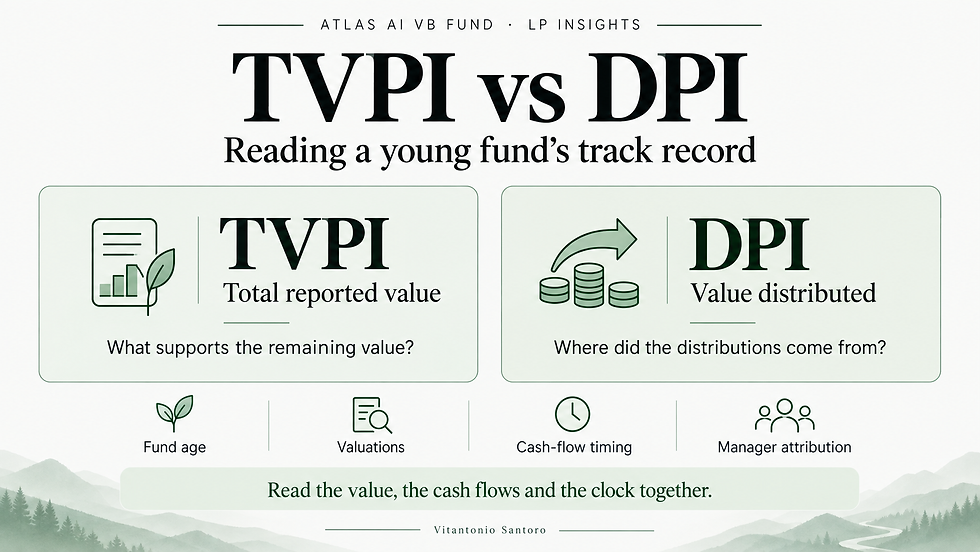
Historical data provides some support for the smaller-fund case. Carta’s April 2025 analysis compared 687 US funds of $1–10 million with 210 funds above $100 million, across the 2017–2024 vintages. For the 2017 vintage, median IRR was 13.8% for the smaller group and 9.8% for the larger group. Smaller funds also generally led on TVPI across the 2017–2021 vintages.
That comparison does not isolate size from strategy or manager quality, excludes the $10–100 million band and includes unrealized valuations. It supports taking small funds seriously; it cannot establish the right size for a particular manager. The stronger investment case remains the combination of accessible opportunities, entry price and ownership relative to fund size.
Staying small requires a viable business
A repeatable strategy needs an organization that can sustain it. A fund that cannot support an effective team, proper diligence, reporting and the follow-on policy it has promised is too small for its own plan. Dependence on an immediate successor fund can also pull partners away from investing and into continuous fundraising.
Additional capital can therefore improve the strategy. It may fund senior investment capacity, support allocations the manager was previously unable to take or provide reserves for attractive follow-ons. The benefit should be identifiable: what constraint does the extra capital remove, and why should removing it improve the investment outcome?
The same scrutiny applies to incentives. A larger fund can increase management-fee income even when the quality of available investments has not improved. LPs should be able to see how the additional economics translate into capabilities, ownership or investment decisions that benefit them.
For an early-stage manager, choosing a limited fund size can be a serious commitment to investment discipline. It remains credible only when the operating budget and portfolio construction are sustainable at that size.
The larger fund should earn its own investment case
When evaluating a larger successor fund, I would ask the manager to reconstruct the previous investment period with the proposed amount of capital. Where would the additional money have gone?
If the answer is larger initial checks, show the allocations founders were prepared to offer. If it is leading rounds, show competitive processes in which founders chose the team for that role. If it is more companies, show the additional opportunities that met the investment standard and who had capacity to own those decisions. If it is follow-ons, show the rounds, prices and capital requirements.
The exercise should use information available at the time. Enlarging only the positions now known to be winners says little about the quality of a future deployment plan.
Then ask where growth should stop. A manager that understands its strategy should be able to explain the point at which more capital would require weaker selection, a different role in rounds or a different type of investment.
That is the significance of a GP who keeps raising $50 million when investors offer more. It is a decision to preserve a model the team knows how to execute. For an LP, that discipline can be more valuable than a larger fundraising announcement.
The right fund size follows from the strategy. A successful fundraising should leave that relationship intact.
Vitantonio Santoro is a General Partner at Atlas AI VB Fund. For a conversation about fund size and early-stage portfolio construction, contact vitantonio.santoro@atlassgr.com.
Numerical examples are hypothetical and do not describe Atlas’s portfolio or expected returns. Updated 30 September 2026.


Comments