Venture Capital Allocation: A Guide for LPs and Family Offices
How much should an LP allocate to venture capital? I would start with the amount the investor can keep funding through a period of delayed distributions, then test whether that programme delivers a worthwhile portfolio exposure. A percentage of wealth is the beginning of the analysis. It does not tell us how much to commit to the next fund.
For a family office, the difficult question is often this: if existing funds return cash two years later than expected, can we still meet their calls, support the family's other obligations and make the investments we want to make next?
My preferred way to answer is to connect three decisions: the desired exposure, the pace of new commitments and the liquidity available under stress.

The data: a recovering portfolio can still consume cash
Cambridge Associates' first-half 2025 benchmark reports $26.9 billion called and $16.1 billion distributed by US VC funds: a calculated $10.8 billion funding gap. Its US VC database contained 2,699 funds at June 2025. These are aggregate historical flows, not a forecast for an individual fund.
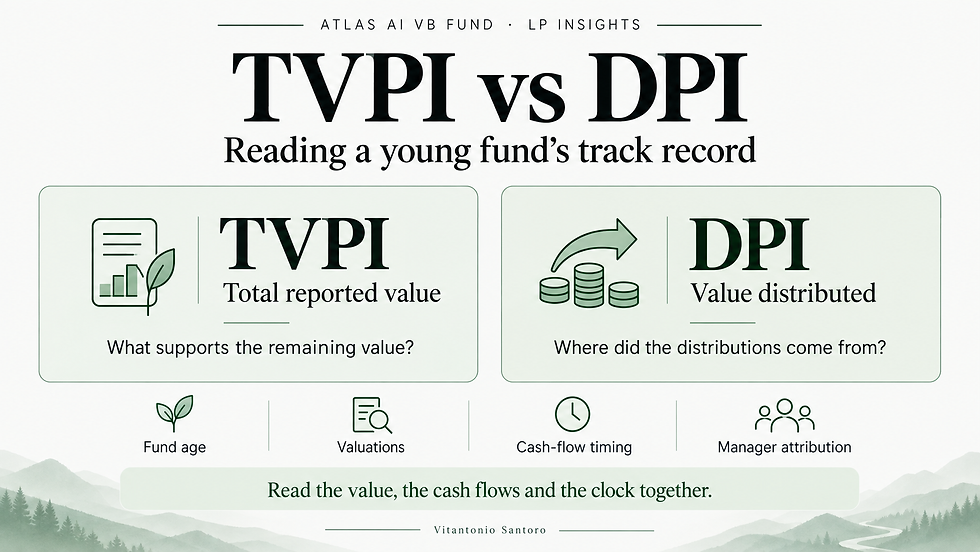
That distinction changes how I interpret a promising portfolio update. Higher valuations may improve reported wealth without increasing the cash available for the next capital call. The relationship between TVPI and DPI matters because valuation progress and financing capacity can move in different directions.
Carta's Q1 2026 report, covering 2,775 funds on its platform, adds another perspective: fewer than half of the funds in each of the 2019 and 2020 vintages had started distributing capital. These are platform cohorts, not the whole VC market.
An LP can therefore believe that existing managers are making progress and still have limited room for another commitment. Treating that decision as a lack of conviction misses the liquidity constraint.
First, define what the allocation percentage measures
A target allocation is usually expressed as a share of a defined investment portfolio. It becomes ambiguous if the numerator switches between commitments, capital paid in and reported net asset value, or NAV.
Measure | What it tells the LP |
|---|---|
Commitment | The amount subscribed under the fund documents; it may be called over time. |
Paid-in capital | Cash already contributed, including amounts used for fees and expenses where applicable. |
Unfunded commitment | Capital still callable under the applicable terms; reconcile recycling and recallable amounts separately. |
NAV | The reported value of the LP's remaining fund interest, which is not necessarily its sale value. |
Consider a hypothetical €20 million investment portfolio containing €1 million of VC NAV and €800,000 of unfunded commitments. Its reported VC weight is 5%. The €800,000 is a future funding obligation; it is neither cash already invested nor an additional €800,000 of current NAV.
The money that will fund those calls may already sit among the portfolio's liquid assets. Adding both the cash and the unfunded commitment as if they were separate owned assets would double count capital. I would show the current allocation and the funding obligations on separate lines.
Even if the investment committee chooses a 10% NAV target, the apparent €1 million gap is not automatically permission to sign a €1 million commitment. Existing funds will call, distribute and change in value; the rest of the portfolio will also move. The target must be translated into a path.
An endowment's percentage is not a family office's answer
In Harry Stebbings' 20VC conversation with Dave Morehead, the Baylor CIO stresses that managers have defined roles within the whole portfolio. A manager changing strategy can undermine that construction even while delivering attractive numbers.
I take a practical lesson from that: before deciding how much venture to own, decide what job it should do. Exposure to young companies, access to a particular stage and a differentiated investment process are more useful answers than “we want more innovation”.
I would then look beyond the fund portfolio. A family might already own a technology business, public growth equities and direct startup investments. An AI fund could add a distinct stage or sourcing channel, while increasing sensitivity to some of the same customers, funding conditions or exit markets. Diversification needs an explanation at that level.
The denominator deserves equal care. In a deliberately simplified example, €2 million of unchanged VC NAV represents 10% of a €20 million portfolio. If the other €18 million falls by 25%, the portfolio becomes €15.5 million and the reported VC weight rises to 12.9%, without any new venture investment. This is a denominator effect, not evidence that the private holdings escaped the downturn.
I would agree an allocation range and a response to that situation in advance. Otherwise, a policy written for normal conditions can create pressure to sell precisely when flexibility matters most.
Build the liquidity budget before the commitment schedule
The useful starting number is the pool of resources genuinely available to finance the programme after other obligations and a minimum reserve. It is rarely the same as total net worth.
Cambridge Associates' work on liquidity planning for wealthy families highlights a particular vulnerability: an operating business may provide less cash just as the investment portfolio becomes less liquid. I would not treat business dividends, asset sales and fund distributions as independent safeguards if they depend on the same market conditions.
My working budget would distinguish:
Cash and assets that can be realised within the required notice period, with explicit allowances for price changes, currency and tax.
Existing obligations across all private investments, alongside family spending, debt service and business needs.
Expected inflows, separated by how dependable they are and when they can actually arrive.
A reserve that is deliberately unavailable for new fund subscriptions.
Borrowing can change the timing of funding. It also creates repayment obligations and may introduce collateral constraints. I would model it separately, rather than count both a securities portfolio and its full borrowing capacity as two independent buffers.
A worked example: the same commitments, two cash outcomes
Here is a separate, hypothetical liquidity model. It is not Atlas data, a market forecast or a recommended allocation.
A family office has €2.2 million available for its VC programme, after providing for other activities. Existing funds can still call €800,000: €500,000 in 2027 and €300,000 in 2028 in this example. The family proposes €1 million of new commitments in each of 2027, 2028 and 2029.
For arithmetic only, each new vintage calls 40% in its first year, 35% in its second and 25% in its third. Those calls include all assumed fund fees and expenses; no extra cost is added outside commitments. There is no recycling, currency movement, interest, additional income or borrowing. The base case assumes distributions from existing holdings of €100,000, €400,000 and €800,000. The stress case postpones all of them beyond 2029.
€ million | 2027 | 2028 | 2029 |
|---|---|---|---|
New commitments signed | 1.00 | 1.00 | 1.00 |
Calls from existing funds | 0.50 | 0.30 | 0.00 |
Calls from the three new vintages | 0.40 | 0.75 | 1.00 |
Total calls during the year | 0.90 | 1.05 | 1.00 |
Base-case distributions | 0.10 | 0.40 | 0.80 |
Year-end liquidity: base case | 1.40 | 0.75 | 0.55 |
Year-end liquidity: no distributions | 1.30 | 0.25 | −0.75 |
The base case ends 2029 with €550,000. With identical calls and no distributions, it has a €750,000 funding shortfall. No investment loss was needed to produce the problem: changing the cash timetable was enough.
There is a second weakness that an annual table can hide. The base case enters 2029 with €750,000. If the full €1 million of that year's calls arrives before the €800,000 distribution, the family temporarily needs another €250,000. A positive year-end balance does not prove that every payment can be made on time. An executable plan needs monthly or quarterly dates, plus a stress case for their order.
There is also a tail. At the end of 2029, the 2028 and 2029 commitments still have €850,000 uncalled: €250,000 and €600,000 respectively. Stopping the model at a convenient date does not extinguish those obligations.
What commitment size would this budget support?
Keep the same three-year call assumptions and let each year's new commitment be C, expressed in millions of euros. By the end of 2029, the new vintages would have called 1.00C + 0.75C + 0.40C = 2.15C.
If the family wants €300,000 left at that date and assumes no distributions, the three-year ceiling is:
C ≤ (€2.2m − €0.8m − €0.3m) / 2.15 ≈ €512,000 per year.
That is only a ceiling for this time window. If the same €2.2 million must cover every remaining call over the life of all three new commitments, with no future inflows and the same €300,000 reserve, the ceiling becomes:
C ≤ (€2.2m − €0.8m − €0.3m) / 3 ≈ €367,000 per year.
Neither number is a recommendation. They show how strongly the answer depends on the horizon and on which future cash receipts the LP is willing to rely on. They test funding capacity; a separate NAV projection is still needed to test the desired portfolio weight.
Consistency has value, but it is not a subscription obligation
Meketa's October 2024 paper on commitment pacing treats allocation as a multiyear commitment process and recommends updating the study at least annually. I would also revisit it after a material change in distributions, family liquidity or the terms of a new fund.
In her 20VC discussion with Harry Stebbings, Beezer Clarkson makes a useful distinction: pausing new commitments does not necessarily stop investment exposure, because existing funds may still be deploying. Their exchange also addresses the risk of losing access to a manager after skipping a fund.
My conclusion is to protect the ability to choose. A sustainable programme can make smaller commitments when necessary without treating every fundraising as an emergency. Equally, preserving access is not a sufficient reason to accept a commitment the family cannot finance.
I would maintain a forward calendar for likely successor funds, alongside the capital already legally committed. The former is a strategic choice; the latter is an existing obligation. Combining them into a single “expected venture spend” makes it harder to see what can still be changed.
What this means for a specialist AI allocation
For an LP considering an AI pre-seed or seed fund, I would put three questions in front of the investment committee: what exposure does it add, what cash demands can it create, and which future opportunities might this commitment crowd out?
A distinct sourcing network or technical selection process can make a fund useful within the programme. Neither feature removes the need to evaluate concentration, pricing and the route to distributions. A stated fund duration also needs to be read alongside extension provisions and the possibility of residual holdings.
I would avoid filling the entire available budget merely because several compelling managers are raising at once. The option to invest in a later vintage has value, although it will not appear in today's NAV statement. Conversely, spreading small tickets across many managers can produce substantial administrative work without meaningful differences in underlying exposure.
Once that role and budget are clear, the next step is the manager-level due diligence described in our family office guide. Portfolio fit and manager quality are separate tests; a strong result on one does not substitute for the other.
Questions LPs frequently ask
Is there a standard percentage to allocate to venture capital?
There is no percentage I would transfer automatically from an endowment or another family. Define the investment portfolio, the role of venture, the capacity for loss and illiquidity, and the cash obligations first. A target becomes useful when a commitment plan can sustain it.
Should unfunded commitments be added to NAV?
They can be shown alongside NAV as a measure of potential future funding exposure, but the sum is not current NAV or cash already invested. Reconcile recallable distributions, recycling and the fund's reporting definitions before using it for planning.
Must all uncalled capital stay in cash?
Not necessarily. The relevant test is whether reliable resources will be available when obligations fall due, including stressed prices and timing. A liquid asset can still fall in value, and a credit line can have conditions. A return target for the waiting capital must be considered together with those risks.
Does a lower NAV create room for another commitment?
It may lower the reported portfolio weight, but it does not automatically reduce existing funding obligations. I would reconcile the unfunded balance and liquidity plan before interpreting a markdown as new investment capacity.
Should an LP stop investing until distributions recover?
That depends on funding capacity and the role of future commitments. Reducing new commitments can protect liquidity, while a complete stop can alter vintage exposure and access. Existing funds may continue investing throughout the pause.
What would make me change the next commitment size?
A smaller dependable liquidity pool, faster calls, deferred distributions, greater overlap with existing holdings or a manager changing strategy. I would change the commitment when those inputs change, even if the headline portfolio allocation remains below target.
Discuss the role of an AI fund in your programme
My starting point is a venture programme that remains financeable when cash arrives late. That makes the discussion with a specialist manager more precise: what role can this fund play within the capital and flexibility the LP actually has?
If you are assessing that role for an early-stage AI fund, contact Vitantonio Santoro at vitantonio.santoro@atlassgr.com, or connect on LinkedIn, to discuss Atlas AI VB's approach.
Research checked on 28 September 2026. Report observations, attributed podcast ideas and hypothetical calculations are distinguished in the text. The examples are educational and do not represent Atlas fund terms, targets or forecasts, or a personalised allocation recommendation.


Comments