Emerging VC Managers: What You Can Know Before the Exits
“Come back when you have a track record.” For an emerging venture capital manager, that request raises a practical question: what does the LP need to see? A first exit, the return of invested capital, or the final result of an entire fund? Each requires a different wait.
During that wait, an LP can already investigate whether the team finds relevant companies, wins allocations and invests with discipline. Those capabilities matter because they are part of how returns are built.
Our view is that backing an emerging manager makes sense when there is credible evidence of a specific investment advantage, a fund designed to use it, and a clear understanding of what remains unproven.

Waiting for a track record can change the opportunity
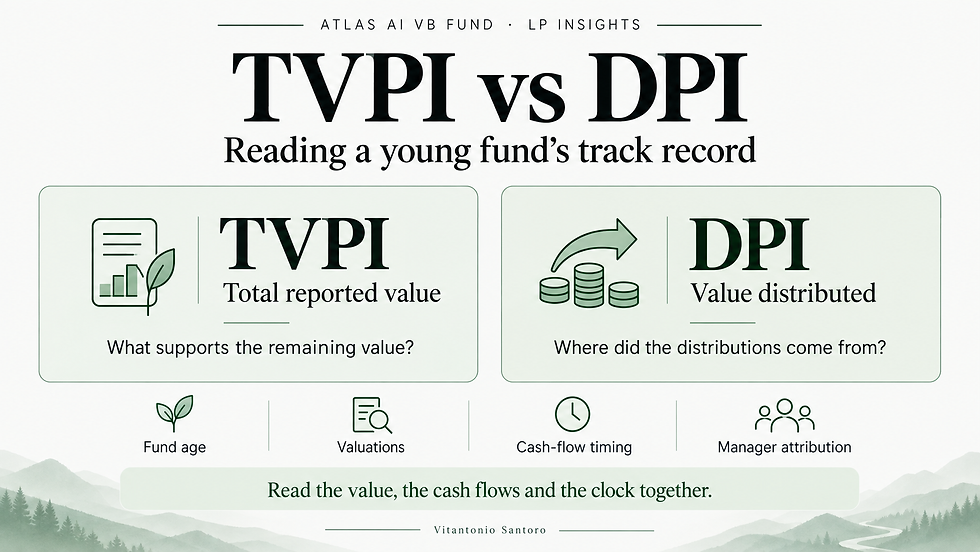
Realized venture returns take time. In Carta’s Q2 2026 VC fund sample, the median DPI for the 2017 vintage was 0.37x. Nearly nine years after inception, the median fund in that group had distributed 37 cents for every dollar paid in. That is a measure of distributions, not the final value of those portfolios.
An LP waiting for a fully realized fund may therefore be evaluating the manager many years later. By then, the team, fund size, investment stage and availability of allocations for new LPs may have changed.
Consider a manager that built its record with a €30 million fund and is now raising €100 million. Larger tickets may require more allocation than founders previously offered. A strategy built around joining rounds may now require winning the lead. The earlier record does not establish that founders will accept either change.
Waiting can provide valuable evidence. Its value depends on how much of the original strategy survives. An LP should be explicit about which uncertainty more time will resolve and whether the later fund will still offer the exposure they wanted.
Judge the decisions behind the record
A first fund can be managed by experienced investors. A successful founder launching a fund may have deep operating knowledge but limited experience selecting investments, setting prices or building a portfolio. Both can be called emerging managers; their capabilities and gaps are different.
Past experience is useful when it resembles the work the new fund will require. An investor who joined a company after product-market fit, alongside an established lead, has faced different decisions from someone investing before there is a product or an institutional round. The company’s eventual success does not make those experiences interchangeable.
The same applies to attribution. Two people can show the same company logo. One found the founders, argued for the investment and negotiated entry. The other worked at the firm that invested. An LP needs to reconstruct what each person actually decided, using the original investment rationale, colleagues and founder references.
The size of the investment also matters. An angel allocation proves that someone was admitted to a round at a particular ticket. It leaves open whether that person could have invested enough to make the position meaningful in the proposed fund.
Mistakes belong in that assessment. What information was available when the decision was made? Which assumption failed? How did the investor respond? A manager who can explain a bad decision precisely gives an LP something concrete to evaluate. A presentation containing only winners makes it difficult to distinguish skill from selective storytelling.
The advantage must work in the new firm
A strong record at an established firm is a starting point. Its brand, available capital, partners and support team may all have helped attract founders and win investments. An independent manager needs to show which of those advantages travel with the people.
The practical question is why a founder with credible alternatives would choose this manager today.
Specialization becomes valuable when it changes that choice. A team may understand a technical constraint, a customer’s buying process or a route to market well enough to help the founder make a better decision. That understanding can create trust before fundraising begins and give the founder a reason to reserve an allocation.
A broad claim such as “we invest in AI” explains very little. The useful evidence is specific: what did the manager understand, how did that help, and did it affect the founder’s decision? Founder references should establish that connection.
For a fund sourcing through founder programs or venture builders, introductions alone tell a similar incomplete story. An LP should ask whether those relationships produce access early enough to evaluate companies, whether the team can select among them, and whether it can secure the intended tickets. Attending the same demo day as everyone else provides limited evidence of privileged access.
The opportunity must also fit the portfolio. Early access to many companies is useful only if enough meet the fund’s criteria and offer terms that make sense. The resulting ownership, after expected dilution, must allow successful investments to contribute meaningfully to the fund.
This is where fund size and manager selection meet. A small, specialized team may have a credible advantage within a particular market. Its fund should be sized to the investments it can realistically win. Raising additional capital creates a new question about where that capital will go and whether the same advantage will apply.
Observe the strategy before the exits
An LP can compare the strategy described at the first meeting with the decisions that follow. The most useful evidence is recorded when those decisions are made, while outcomes are still uncertain.
Selection becomes visible in investment memos and documented passes. They show what the team believed, what it considered too expensive or too risky, and what would have changed its mind. Reviewing the full set of decisions makes it harder to rewrite the investment thesis around whichever companies later perform.
Access becomes visible in completed investments: the ticket obtained, the entry terms and the role the manager actually played. A team promising to lead rounds should be able to show founders choosing it for that responsibility. A team planning smaller collaborative tickets should demonstrate that those allocations are consistently available.
Discipline becomes visible in portfolio construction. Are stage, ticket sizes and prices consistent with the proposed strategy? Have exceptions remained limited and well explained? A portfolio assembled under fundraising pressure can end up very different from the one an LP originally assessed.
Learning becomes visible when companies miss expectations. Does the manager identify the cause, revise the assessment and communicate it clearly? A change of view supported by new evidence can be more informative than repeated confidence in the original thesis.
The firm also needs the resources to sustain this work. The team’s budget, responsibilities and operating arrangements should support investing and managing the portfolio through a slower fundraising period. Otherwise, the need to keep the management company running may begin to dictate investment pace or the size of the next fund.
These observations can establish whether important parts of the strategy work. Realized returns are still needed to demonstrate the result for LPs, after losses, dilution, fees and the time taken to return capital. Strong early execution cannot settle that question.
An LP should be able to state the investment case precisely: this team has relevant experience, a reason founders choose it, and evidence that it can build the proposed portfolio at this fund size. If one of those links is missing, waiting should have a purpose: identify the evidence needed and revisit the decision when it exists.
A short history of distributions may reflect the age of a fund. A weak explanation of why the manager can win requires a different answer.


Comments